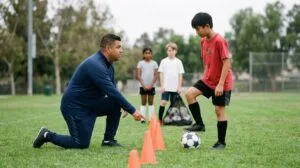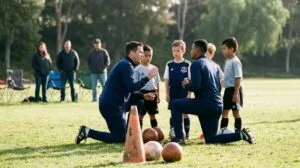
When you search “private soccer coach near me,” distance should be the last filter, not the first. What actually changes a player is diagnostic ability: can the coach find the fault in ten minutes and give cues the kid remembers on Saturday? Coach Elmer Chacon holds a USSF B License – the fourth-highest certification in U.S. Soccer, two levels below the MLS requirement – currently coaches at the MLSNext level with Strikers FC Irvine, and has spent nearly 20 years developing West Coast players. Private sessions run 1 to 2 hours, weekly or bi-weekly, in Orange County. You can book a training session here or call (714) 248-2592.
The belief most parents arrive with
Most families start this search assuming private training is interchangeable: someone who knows soccer, a bag of balls, a park within 15 minutes, an hourly rate. Pick the closest one, get more touches.
That assumption is the expensive part. Extra touches without direction just make an existing habit permanent. A player who plants the wrong foot on every strike does not need 300 more reps of that. They need someone who can see it early, explain why it is happening, and rebuild it in a sequence the player can feel.
You are not buying an hour of field time. You are buying a diagnosis. Everything below is about how to tell whether the person you are calling can actually make one, and it is the same logic behind sorting a list of local soccer coaches by license and current coaching role rather than by miles, the same reasoning behind deciding which coach in Orange County is actually the best rather than merely the nearest, and the same screening process Orange County parents can use before booking a trainer.
What an actual 60-minute session looks like
Here is a composite of a real first session, details anonymized. Ten-year-old boy, competitive club, dad’s complaint on the phone was “he disappears in games.”
Minutes 0-10, diagnostic. No lecture, no warmup speech. Elmer puts the player in simple pass-and-receive work and watches three things: what the first touch does under a little pressure, where the plant foot lands on strikes, and whether the head comes up before the ball arrives. Most parents expect the first ten minutes to be conditioning. It is observation, and it is the most valuable part of the hour.
The fault found. Two, actually, and they were connected. The plant foot was landing behind the ball on strikes, so everything ballooned. And the first touch, when a defender closed, went straight into his own feet, which is why he looked slow and why he “disappeared” – he was not slow, he was stuck.
The three cues. Plant beside the ball, not behind it. Touch across your body, into space, away from pressure. Check your shoulder before the ball arrives, not after. Three cues, not fifteen. A ten-year-old can hold three.
Homework between sessions. A short daily block against a wall with the same three cues, done at game speed rather than comfortable speed, plus one instruction to the parent: watch the plant foot at the next game and say nothing about it in the car.
Four weeks later. The strikes stayed down. The bigger change was the shoulder check, which is not a skill so much as a habit, and once it was there his first touch had somewhere to go. He stopped looking slow. His coach thought he had gotten faster. He had not. He had gotten earlier.
That sequence – watch, name the fault, three cues, homework, retest – is the mechanism. Everything else is packaging.
Credential #1: the license, and what it actually signals
The USSF B License is the fourth-highest coaching certification in U.S. Soccer, two levels below what is required to coach in MLS, and very few private trainers hold it.
The license matters less as a wall decoration and more as evidence of what a coach was tested on: player development pathways, tactics, and teaching methodology. Plenty of good former players can demonstrate a skill. Far fewer can break it into three cues a 12-year-old remembers under pressure. That is the difference between running drills and teaching the game, and it is the core of how parents should judge soccer coaching in Irvine and Orange County.
Credential #2: is the coach still coaching competitively?
Ask any prospective trainer what team they are currently coaching and at what level. A trainer who only does private sessions has no live feedback loop on what today’s game demands.
Coach Elmer coaches at the MLSNext level with Strikers FC Irvine, the highest tier of youth competition in the country. In his first season as Head Coach at Fairmont Preparatory Academy, he took the boys’ program to the CIF quarterfinals for the first time in school history. He has served as Director of Coaching for California Rush, as Youth Director and Technical Director, and holds regional and national championships as both a player and a coach, with clubs including Irvine Strikers and Slammers Huntington Beach. That combination of a named license and a current competitive role is exactly what parents should be judging soccer coaching on in Irvine and Orange County. The full background is here.
What that means for your player: a coach working at MLSNext level knows precisely what the next rung looks like, whether that rung is a stronger club team, a high school starting spot, or a college roster.
Credential #3: range
Elmer has coached first-time toddlers in programs he built himself and elite, college-bound competitors. Range is what lets a coach meet a player where they actually are instead of running the same template on everyone. A trainer who has only ever worked with one age band will teach your kid that band’s session regardless of what the diagnostic says, when an 8-to-11-year-old, a 12-to-16-year-old, and a high school or elite player each need a different emphasis at their stage of development.
What we are not good for
An honest trainer will tell you when to spend your money elsewhere. Top Notch Training will turn away or redirect:
- Players under about six. At that age the need is play, not correction. A structured 1-on-1 hour is the wrong tool and the family will not see a return on it.
- Players whose parents want the sessions more than they do. The stated standard is that the player brings effort and energy and is coachable. If the kid is being dropped off against their will, no cue survives the drive home.
- Athletes already training five days a week. Adding a sixth session to a full club load is not development, it is load. Sometimes the honest recommendation is fewer sessions and a parent guidance conversation instead.
- Families looking for a guaranteed pathway. Elmer’s players have gone on to play at higher levels while excelling academically, but that comes out of the work, not out of a purchase.
Private is not always the right starting point
1-on-1 is best when a player has a specific, identifiable block: a weak left foot, a first touch that dies under pressure, a position change, a confidence dip. Weekly group training is often better for players who need competitive repetition, speed of play, and pressure from peers at a similar level. Either way, training sits alongside the recreational and club tracks families choose between in Orange County, rather than replacing them.
Many families run both – private work to fix the mechanics, group work to test whether the fix holds when someone is closing them down. The programs page lays out group trainings, camps, private sessions, and parent guidance side by side, and this walkthrough of how to choose between the four development formats in Irvine helps you match the format to the problem you are actually seeing. Camps are worth a look during school breaks for a concentrated block, and parent guidance meetings can happen in person in Orange County or by phone or Zoom from anywhere in the world.
The standard, stated plainly
“If your player provides the effort and energy, is coachable, and willing to bring effort and energy to train, I can help transform them into a better player and individual.”
That puts a real requirement on the athlete, which is the honest way to do it. Parents consistently report the difference showing up in confidence and how their kid carries themselves, not only in the play.
One next step
If your player is putting in the effort and still looks stuck, the useful thing is not another year of hoping it clicks. It is one hour with someone who can name what is actually wrong. Private sessions run 1 to 2 hours, weekly or bi-weekly. To register you create an account, activate it by email, then come back to reserve your spot. Pay at the event or via Zelle, 24 hours’ notice on cancellations. If you want to see the calendar first, check the training schedule, or join the announcement list for $25 off your first training plus notice of camps and clinics before they fill.
Call (714) 248-2592 and describe what you are seeing in games. That conversation costs nothing and usually tells you within five minutes whether private training is even the right answer.
FAQ
How much does a private soccer coach cost near me?
As of August 2026, private 1-on-1 soccer training in Orange County generally runs about $75 to $150 per hour, a wide bracket because it mixes unlicensed trainers with licensed, actively coaching ones. Top Notch Training’s own rates are $95 per hour for private 1-on-1 and $50 to $70 per player per hour for small group, depending on group size. Travel to your field and any field or facility fees can affect the total, and adding a sibling or teammate makes it a small-group session at the lower per-player rate. For a fuller breakdown of how private and small-group sessions work in Irvine and what moves the cost, start there. Call (714) 248-2592 for current pricing on the exact format you want – tell them the length, the location, and how many players, and you will get a real number rather than a “starting at” figure.
What certifications should a private soccer coach have?
Ask for a U.S. Soccer license and ask specifically which one. The USSF B License is the fourth-highest certification in U.S. Soccer, two levels below what is required to coach in MLS, and very few private trainers hold it. Then ask a second question most parents skip: what team are you currently coaching, and at what level? A coach still working competitively has a live read on what the next level demands. Those two questions are part of the five questions that screen any trainer in Irvine and Orange County, and for the rest of the questions worth asking, see this parent’s checklist for evaluating a youth soccer coach.
How often should my kid do private soccer training?
Top Notch private sessions are structured weekly or bi-weekly, which leaves enough space between sessions for a player to absorb and apply the homework instead of just accumulating hours. If your athlete is already training five days a week with their club, the honest answer is often bi-weekly at most, or none at all until the load comes down.
Is private training better than group training for young players?
Not automatically. Private training is best for diagnosing and fixing one specific limitation, because the coach sees exactly what is holding the player back. Group training supplies repetition, competitive pressure, and speed of play against peers at a similar level. Fixing something in private and never testing it under pressure is how a “fix” quietly disappears by the next game.
My kid does not want to be coached. Should I book anyway?
No. The stated standard is that the player brings the effort and energy and is coachable. If the sessions are your idea and not theirs, start with a parent guidance conversation instead – those can be in person in Orange County or by phone or Zoom from anywhere – and work out what is actually going on before spending on field time.
Do you offer soccer training outside Orange County?
On-field training is based in Southern California. Parent guidance meetings can be held in person if you are local to Orange County, or by phone or Zoom from anywhere in the world.
How do I book a session?
Create an account, click the activation link in your email, then return to reserve your spot for the session or event you want. You can pay at the event or via Zelle, and cancellations require 24 hours’ notice. Call (714) 248-2592 if you would rather talk it through first.
Reviewed by Elmer Chacon, USSF B Licensed; MLS Next 2 Academy Division coach (U17 and U19) at Strikers FC Irvine since 2022; Head Coach at Fairmont Preparatory Academy; 2025-26 Western Athletic Conference Boys' Soccer Coach of the Year - last updated September 4, 2026.
Sources for this article
- USSF B License is the fourth-highest coaching certification in U.S. Soccer, two levels below what is required to coach in MLS; very few private trainers hold it
- Elmer currently coaches at the MLSNext level with Strikers FC Irvine, the highest tier of youth competition in the country
- First season as Head Coach at Fairmont Preparatory Academy: boys' program reached CIF quarterfinals for the first time in school history
- Nearly 20 years coaching across West Coast soccer
- Served as Director of Coaching (California Rush), Youth Director, Technical Director
- Regional and national championships as both player and coach; Irvine Strikers and Slammers Huntington Beach
- Range from first-time toddlers to elite, college-bound competitors
- Coaching standard quote: effort, energy, coachability
Facts drawn from this site's own documented knowledge and first-hand experience.