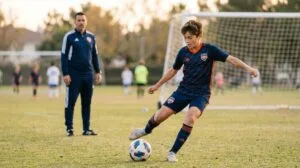
A youth soccer development program is supplemental training built around the individual player, not the team, and in Irvine that means four formats: weekly group training, school-break camps, private 1-on-1 sessions, and parent guidance. Pick by naming the problem. One stuck skill points to private work. A player who needs pressure points to weekly group. A school-break gap points to a camp. Resistance at home points to a conversation before any field booking. Costs and group sizes vary by session length and format, so ask for the current figure in writing before you commit.
- Rec and club are your player’s team. A development program is how they improve between team practices.
- Private 1-on-1 runs 1 to 2 hours, weekly or bi-weekly, and suits one named limitation.
- Weekly group training supplies competitive repetition and speed of play against similar-level peers.
- Camps concentrate several days of technical work and game situations during school breaks.
- No program can promise team placement. The player brings the effort, energy, and coachability.
You are not worried about soccer. You are worried they will quietly stop
Most parents who call are not chasing a scholarship. They are watching a kid who used to ask to go to practice start dragging their bag to the car. Or a player who is technically fine in warmups and invisible once the game speeds up.
That is a solvable problem, but only if you name it before you buy anything. The single most expensive mistake in Orange County youth soccer is buying a format that does not match the problem, then concluding training does not work, which is why it helps to choose a soccer program by problem rather than by price per hour.
The belief worth correcting: making the club team is not the development plan
The most common assumption we hear is that once a player makes a club roster, development is handled. It is not. A club team’s job is to win games in a league, and a good club coach is doing that while managing 16 to 18 kids and a season schedule.
Nobody in that setting has 40 minutes to rebuild a weak-foot mechanic or teach a player to receive on the half-turn under pressure. That gap is why supplemental programs exist. If you are still mapping the local landscape, our guide to Orange County youth soccer leagues, clubs, AYSO, and training explains how the three tracks fit together.
More than 800 youth, club, and high school players have trained with Top Notch Training as of August 2026, and the ones who improve fastest are almost never the ones with the most impressive team badge. They are the ones getting extra touches every week.
Match the format to the problem
Every player develops differently. Some need more touches. Some need confidence. Some need sharper decision-making. Some need a coach who will push them, teach them, and hold them accountable. Start by naming which one it is, then read across the row.
| Format | Best for | Structure and days | Cost and group size | Where |
|---|---|---|---|---|
| Weekly group training | Repetition, speed of play, pressure from similar-level peers | Consistent weekly sessions; weekday schedule varies by age band, see the current schedule | Per-session and package rates vary; group size is capped by age band and level, ask for the current cap | Irvine and Orange County |
| Private 1-on-1 | A named block: weak left foot, first touch under pressure, a position change | 1 to 2 hours, weekly or bi-weekly, day set with the coach | Hourly rate varies with session length and whether it is 1-on-1 or small group; small group splits the cost across players | Orange County fields |
| Camps | A concentrated block during school breaks | Several days, technical plus game situations; past camps ran mornings | Per-camp price varies by number of days and hours; check the current camp listing | Irvine and Orange County |
| Parent guidance | Motivation, confidence, expectations at home | Conversation with the parent, scheduled directly | Varies; one parent, no field time | In person in OC, or phone/Zoom anywhere |
What moves the number in every row is the same short list: session length, how many players share the coach, and how many days a camp runs. Top Notch Training charges $95 per hour for private 1-on-1 and $50 to $70 per player per hour for small group, depending on group size, with weekly group sessions at $45 (ages 9 to 12) and $55 (ages 12 to 17); the private and small-group training page carries the full breakdown and booking steps. If a coach will not give you a written all-in figure, that is information too.
Weekly group training
Group sessions put players with others at a similar age or level so they get repetition, pressure, and coaching week after week. That combination is what builds touch, movement, speed of play, and decision-making. For Youngers (8-11), whose real needs are touches and confidence, weekly group work does most of the job on its own.
Private 1-on-1
Private sessions let a coach see exactly where a player is and what is holding them back. They are diagnostic first, corrective second. But fixing something in a private session and never testing it under pressure is how a “fix” quietly disappears by the next game, which is why most players do best with private and group together.
School-break camps
League and club calendars leave gaps: winter break, spring break, and the long summer stretch that lands on either side of the May-June tryout window. Camps fill those weeks with technical work, attacking and defending concepts, game situations, and competitive play across several days. Past camps have run mornings at Oak Creek Park in Irvine for boys and girls ages 6-16, and dates and locations vary by camp. Before comparing prices, read how to choose a youth soccer camp in Orange County, because the coach-to-player ratio at each station tells you more than the hours do.
Parent guidance
Player development is not only what happens on the field. Parents shape confidence, expectations, motivation, and how a young athlete handles mistakes and setbacks. Those meetings happen in person if you are local to Orange County, or by phone or Zoom from anywhere in the world. More on that in our piece on supporting your player off the field.
What the age bands actually need
Programs are organized in three bands, and the honest answer for each is different. Youngers (8-11) need touches and confidence: a comfortable relationship with the ball and the habit of trying things. Weekly group training with similar-level peers carries most of that load, and rec or club both work fine as the home team.
Olders (12-16) are where speed of play and decision-making separate players, and where a single unaddressed weakness starts costing minutes. High School and Elite players are usually working on position demands, work rate, and consistency under pressure, which is where 1 to 2 hour private sessions weekly or bi-weekly earn their place, with group work to test the change live.
The players I remember are rarely the most gifted ones. They are the 12-year-old who could not turn away from pressure in the fall and by spring was checking her shoulder before the ball arrived, because we drilled it every week until it stopped being a decision. That is what consistency buys. If a player does not want to be there, I would rather talk to the parent first. The standard across every program is the same: the player brings the effort, the energy, and a willingness to be coached. Everything else I can teach. – Coach Elmer Chacon
Decide it now: four branches, four next clicks
Read the four statements below and pick the one that sounds most like your house this month. Only one. If two apply, the resistance branch always goes first, because effort is the input every other format depends on.
“There is one thing they cannot do”
A weak left foot, first touch under pressure, a position change. That is a named block, and it is what private work is for, in 1 to 2 hour sessions weekly or bi-weekly. Next click: private and small-group training details and current rates.
“Fine in drills, invisible in games”
They need pressure, tempo, and peers at their level, not more isolated reps. That is weekly group training, week after week, not a burst. Next click: the current training schedule to find the day and age band that fits.
“They have three weeks off and nothing on”
Winter, spring, or summer break is either lost time or a concentrated block of touches. That is a camp. Next click: book training and check current camp dates.
“Extra training is my idea, not theirs”
Do not book field time yet. Start with a parent guidance conversation, in person locally or by phone or Zoom. Next click: request a parent guidance conversation.
Still not sure who to train with at all? Our parent’s checklist for choosing a youth soccer coach in Orange County is a better use of an evening than another round of search results, and if you have already typed “soccer trainer near me” into a search bar, that screening process shows you what to check before the price. For a format-by-format walkthrough with the questions to ask, see our companion piece on how to choose a youth soccer development program in Irvine.
Frequently asked questions
What is a youth soccer development program?
It is supplemental training aimed at the individual player rather than the team. Recreational leagues like AYSO and city rec handle exposure and fun. Club programs handle competition. Development programs, meaning weekly group training, camps, and private sessions, are the only track built around improving one player’s specific skills.
How much does youth soccer training cost in Irvine?
Private training is $95 per hour and small group is $50 to $70 per player per hour; weekly group sessions are $45 (ages 9 to 12) and $55 (ages 12 to 17), and camps are posted with their dates. What moves the price is consistent: how long the session runs, how many players share the coach, how many days a camp covers, and whether you book singles or a block. Ask any coach for a written all-in number before you commit.
Is private training better than group training for young players?
Not automatically. Private training is best for diagnosing and fixing one specific limitation, because the coach sees exactly what is holding the player back. Group training supplies repetition, competitive pressure, and speed of play against peers at a similar level. Most players benefit from both, and younger players often need the group side more.
Can a development program get my child onto a club team?
No coach can promise team placement, and you should be skeptical of anyone who does. Selection belongs to club coaches and depends on their roster needs that year. What training can do is improve what coaches actually evaluate at tryouts: first touch, both feet, decision speed, defensive work rate, and coachability.
When should we start training before club tryouts?
Club tryouts in Orange County generally run late May through June, with some clubs adding July sessions for spots that did not fill. The improvement that changes a tryout result gets built in the months beforehand, not the week of. Confirm dates directly with each club, since they publish independently.
What ages do you train in Irvine?
Three bands: Youngers (8-11), Olders (12-16), and High School/Elite. Seasonal camps have run for boys and girls ages 6-16. On-field training is based in Irvine and Orange County, while parent guidance can happen by phone or Zoom from anywhere.
My kid does not want extra training. Should I sign them up anyway?
No. If the sessions are your idea and not theirs, start with a parent guidance conversation and work out what is actually going on before spending on field time. Field time cannot manufacture willingness, and a player who is dragged to sessions learns to dislike the game faster than they learn to strike a ball.
What changes if you get this right
Six months from now the difference is not a badge. It is a kid who checks their shoulder without being told, who wants the ball when the game gets loud, and who still asks to go to training. Name the problem, pick the branch that matches it, and give it enough weeks to show up on a Saturday.
Reviewed by Elmer Chacon, USSF B Licensed; MLS Next 2 Academy Division coach (U17 and U19) at Strikers FC Irvine since 2022; Head Coach at Fairmont Preparatory Academy; 2025-26 Western Athletic Conference Boys' Soccer Coach of the Year - last updated September 4, 2026.
Sources for this article
- Four formats (group training, camps, private 1-on-1, parent guidance) from the Programs post
- Private sessions 1 to 2 hours, weekly or bi-weekly (Programs post)
- Parent guidance in person in OC or by phone/Zoom from anywhere (Programs post, pillar FAQ)
- Age bands Youngers 8-11, Olders 12-16, High School/Elite (coach checklist post)
- Camps have run for boys and girls ages 6-16; past camps mornings at Oak Creek Park, Irvine; dates/locations vary (Christmas camp post, pillar post)
- Club tryouts late May through June, some July sessions; confirm with each club (pillar FAQ)
- No coach can promise team placement; tryout evaluation criteria: first touch, both feet, decision speed, defensive work rate, coachability (pillar FAQ)
- Club team is not a development plan; coaches manage 16 to 18 kids (pillar post)
Facts drawn from this site's own documented knowledge and first-hand experience.