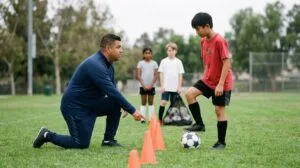
First touch training in Irvine and Orange County is almost never a volume problem. The fault we see most is a first touch that dies at the player’s own feet when a defender closes, which makes a player look slow when they are actually stuck. To improve first touch, Orange County families need one named fault, three cues, and 15 minutes a day of first touch drills against a wall – not 300 more reps of the same broken habit.
- A dying first touch is usually body shape and scanning, not foot surface.
- Three cues, not fifteen: plant beside the ball, touch across your body into space, shoulder check before the ball arrives.
- Homework: 15 minutes a day, five days a week, at game speed.
- Watch your player’s head in the two seconds before the ball arrives, not the ball.
- The sessions that change a player start by naming one fault, not by stacking more drills on top of it.
The belief worth putting down first
Families usually arrive assuming private training is interchangeable. Someone who knows soccer, a bag of balls, a park fifteen minutes away, an hourly rate. Under that assumption, first touch is a counting problem: more touches, better touch.
Extra touches without direction just make an existing habit permanent. A player who plants the wrong foot on every strike does not need 300 more reps of that strike. They need someone who sees it early, explains why it happens, and rebuilds it in a sequence the player can feel. You are not buying an hour of field time. You are buying a diagnosis.
If you are still mapping how clubs, AYSO, and trainers fit together locally, our Orange County youth soccer guide to leagues, clubs, AYSO, and training sets the landscape. This page is about one skill inside it.
Programs and booking
Three formats, all run on Orange County fields with the specific park confirmed when you book, based on permits and season. Pick the one that matches the problem you named, not the one that sounds like the premium tier. Book a session or call (714) 248-2592 and describe what you see in games.
- Private 1-on-1 training (ages 8-11, 12-16, and High School/Elite). 1 to 2 hours per session, weekly or bi-weekly, on an Orange County field. Best for one named block: a first touch that dies under pressure, a weak left foot, a position change.
- Small-group and weekly group sessions (ages 8-11, 12-16, and High School/Elite). Consistent weekly sessions in Irvine and Orange County. Best when the mechanics hold up in drills and disappear the moment the game speeds up, because what is missing is competitive repetition and speed of play against similar-level peers.
- Team sessions and school-break camps (ages 8-11, 12-16, and High School/Elite). Camps run several days across a school break in Irvine and Orange County, technical work plus game situations, which is a concentrated block a single weekly hour cannot match.
Booking works the same way for all three: create an account and activate it by email, come back and reserve your spot, then pay at the event or via Zelle. Cancellations need 24 hours’ notice. Joining the announcement list gets you $25 off your first training plus notice of camps and clinics before they fill. Private training is $95 per hour and small group is $50 to $70 per player per hour. For a fuller walkthrough of formats and costs, see our Irvine private and small-group training page.
What to watch for from the sideline
Watch one thing on Saturday: when a defender closes, does the ball go into space, or straight into your player’s own feet?
A player whose touch dies at their feet looks slow. They are not slow. They are stuck. The second touch becomes a panicked pass backwards, and the sideline read becomes “he disappears in games.”
The second tell is the head. If your player scans only after the ball is already on their foot, every decision is made under maximum pressure with minimum information. A player who never turns is usually a player who did not know what was behind them.
Parents often describe this as nerves. “She gets nervous.” It is not nerves. It is body shape before the ball arrives.
The three cues, and how to grade them at home
Cue economy matters more here than anywhere. Three cues, not fifteen. A ten-year-old can hold three.
- Plant beside the ball, not behind it.
- Touch across your body, into space, away from pressure.
- Check your shoulder before the ball arrives, not after.
Each cue has a visible wrong version and a visible right version, which is what makes it gradeable by a parent with no coaching background. Plant foot behind the ball means the strike balloons. Plant foot beside the ball means the ball stays down. Touch into the feet means the next action is backwards. Touch across the body into space means the first touch is already the start of the next action. Head up after the ball arrives means the decision is late. Head up before it arrives means the touch has somewhere to go.
These same three cues carry into Olders (12-16) and High School/Elite. The mechanics do not change between 11 and 14, the speed does, and so does the environment they get tested in. Our breakdown of what players need at 8-11, 12-16, and high school level goes deeper on that progression.
What the first ten minutes of a session actually look like
The mechanism: watch, name, cue, homework, retest. The order does not change. Everything else is packaging.
- Watch. Minutes 0-10 are simple pass-and-receive observation, not conditioning.
- Name one fault. It is usually the plant foot, the first touch under pressure, or the timing of the head.
- Give three cues. Not fifteen. A ten-year-old can hold three.
- Set the homework. Fifteen minutes a day, five days a week, at game speed.
- Retest on Saturday. If the cue does not transfer to the game, the fault was named wrong and the trainer starts again.
Take a case, details anonymized. Ten-year-old boy, competitive club. The dad’s complaint on the phone was that he disappears in games.
Minutes 0-10 were observation, not conditioning, which is what most parents expect. Simple pass-and-receive work while the coach watched three things: what the first touch does under a little pressure, where the plant foot lands on strikes, and whether the head comes up before the ball arrives.
Two faults surfaced, and they were connected. The plant foot landed behind the ball, so strikes ballooned. The first touch, when a defender closed, went into his own feet, so he had nowhere to go. Three cues followed, then homework. Four weeks later his coach thought he had gotten faster. He had not. He had gotten earlier.
The homework, written out so you can use it without booking anything
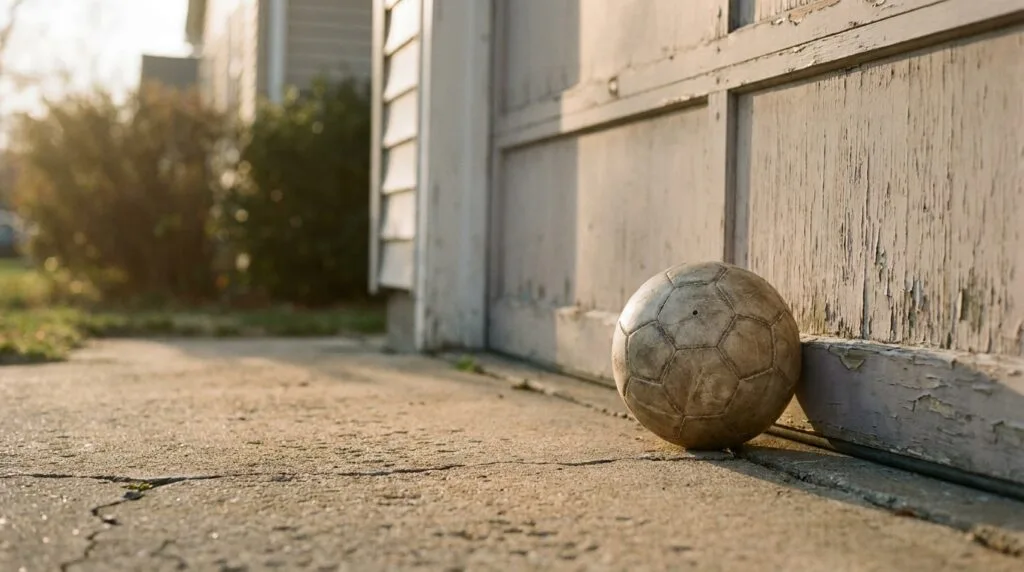
This is the between-session block that carried that case, and any family can run it against a garage door or a park wall. 15 minutes a day, five days a week. Shorter and daily beats one long weekend session.
- 5 minutes: 40 strikes against the wall, alternating feet, one thought only – plant beside the ball. Count them out loud so the rep is deliberate.
- 5 minutes: 50 first touches off the rebound, every touch pushed across the body into space, never back into the feet.
- 5 minutes: same rebound work, but a shoulder check before every ball arrives. 30 reps.
Do all of it at game speed, not comfortable speed. Comfortable speed builds a habit that vanishes under pressure.
One instruction for the parent: watch the plant foot at the next game, and say nothing about it in the car.
What should change, and roughly when
By the end of week two you should see two things: strikes staying below head height more often than not, and the head turning before the ball arrives instead of after. The shoulder check is the one to watch, because it is a habit rather than a skill, and once it is there the first touch has somewhere to go.
By week four, in the case above, the change was visible to someone who did not know the plan: the club coach read it as speed. Beyond that, the honest answer is that timelines vary by player, age band, and how heavy the club season is. Anyone quoting you a guaranteed date is selling, not coaching.
When it is not a touch fault at all
The shape of a wrong diagnosis looks a lot like the shape of the right one, which is the problem.
One player’s first touch kept dying under pressure and got the obvious read: a technical touch fault, so the first session was built around the touch. It held up in the drill and fell apart in the game. Watching again, the touch was fine whenever she had already decided where the ball was going. What was missing was the decision before the ball arrived, not the surface it came off. The plan changed to scanning and choosing a side early, and the touch cleaned itself up as a byproduct.
If the cue does not transfer to Saturday, the fault was named wrong, and it is the trainer’s job to say so and start again.
Grade your player at the next game: private hour or group session?
You do not need a trainer in the stands to score this. Pick one game, watch your player rather than the ball, and grade the three cues. Say nothing about it in the car.
| Cue | Pass looks like | Fail looks like | What to do |
|---|---|---|---|
| Plant beside the ball | Strikes stay down, below head height more often than not. | Strikes balloon, because the plant foot lands behind the ball. | Stay on the 5-minute wall block, 40 strikes alternating feet, one thought only. |
| Touch across the body into space | The first touch is already the start of the next action, going away from pressure. | The touch dies at their own feet and the second touch is a pass backwards. | Body shape before the ball is still the fault, so keep the private diagnosis work going. |
| Shoulder check before the ball arrives | The head turns in the two seconds before the ball reaches them. | They scan only after the ball is on their foot, so every decision is late. | Add the 5-minute rebound block with a shoulder check before every ball, 30 reps. |
Score the whole game, not one moment. If all three pass in drills and at home but disappear the moment the game speeds up, the mechanics are fine and what is missing is competitive repetition, which is group training rather than another private hour. If two or three fail, the fault has not been named correctly yet, and that is a conversation to have before booking anything else. If the fix is holding even when the game speeds up, keep the session cadence light and keep the homework.
Here is the same fault one band up, in Olders (12-16). Unopposed, the player looks clean. Add a defender at their shoulder and the first touch goes square across the body into traffic, so the second touch is a panicked pass backwards. In session it gets isolated fast: a receiving pattern with a passive defender at the back shoulder, then a live one, with the player forced to take the first touch on the back foot and out of pressure. The cue is short on purpose: “Look before it comes, touch away from him.” Six words, because a paragraph of coaching does not survive a game.
Our page on picking the right training format in Irvine lays out how weekday group trainings, seasonal camps, and private or small-group sessions each fit.
Screening a first-touch trainer on the phone
Two questions, asked verbatim, sort a local list faster than distance does.
First: “Which USSF license do you hold, by name?” A good answer names the license. A bad answer is a vague “I’m certified.” Verify through the US Soccer Learning Center, or ask for the license number and issue date.
Second: “What team are you coaching right now?” A current competitive role means the read on what today’s game demands is live, not remembered.
Our screening process for Orange County parents walks the rest of the call, question by question.
How to judge the session afterward
A hard session is not automatically a good session. A player can sweat for an hour and learn nothing. Sweat is easy to produce. Diagnosis is not.
Ask your player one thing: what did the coach tell you to fix? A specific fault plus a cue they can repeat back is a real signal. “We did a lot of dribbling” tells you something too.
The pattern is consistent: the sessions that change a player start by naming one fault, not by stacking more drills on top of it.
Meet your coach: Elmer Chacon
The training on this page is run by Coach Elmer Chacon, working on Orange County fields out of Irvine.
- Coaching license: USSF B License, the fourth-highest coaching certification in U.S. Soccer and two levels below what is required to coach in MLS. You are welcome to verify it through the US Soccer Learning Center, or ask for the license number and issue date.
- Current competitive role: coaching at the MLSNext level with Strikers FC Irvine, so the read on what today’s game demands is live rather than remembered.
- Years coaching: nearly 20 years, on the West Coast.
- Who he works with: youth, club, and high school players in the Youngers (8-11), Olders (12-16), and High School/Elite bands, in private 1-on-1, small-group and weekly group sessions, team sessions, and school-break camps.
A photo of Coach Chacon on the field belongs with this section, and we will add it here.
FAQ
First touch drills for youth soccer players: what should we do at home?
Use a wall or garage door, 15 minutes a day, five days a week: 5 minutes of 40 strikes alternating feet with one cue, 5 minutes of 50 first touches off the rebound pushed across the body into space, and 5 minutes of the same rebound work with a shoulder check before every ball, 30 reps. Do it at game speed. Shorter and daily beats one long weekend session.
Why does my child look slow on the field even though they’re fast?
Usually they are not slow, they are stuck. If the first touch goes into their own feet when a defender closes, there is nowhere to go with the second touch. And if they scan only after the ball is on their foot, every decision gets made under maximum pressure with minimum information. Fixing the shoulder check often reads to a club coach as a speed improvement.
Is private training or group training better for first touch?
It depends on where the fault sits. If the mechanics are wrong, a private hour with a real diagnosis is the faster path. If the mechanics hold up in drills but vanish when the game speeds up, the player needs competitive repetition, which group training provides. A trainer who tells you the second one is the honest one. For what each format involves and how booking works, see our Irvine private and small-group training page.
How do I verify a soccer trainer’s coaching license?
Check the US Soccer Learning Center, or ask the trainer directly for the license number and issue date. Then ask what team they are coaching right now. A current competitive coaching role tells you their read on the game is live rather than remembered.
What is a first touch in soccer?
The first touch is what the player does with the ball the instant it reaches them. A good one puts the ball across the body into space, away from pressure, so the first touch is already the start of the next action. A poor one dies at the player’s own feet, which leaves nowhere to go and turns the second touch into a panicked pass backwards.
At what age should a player start first touch training?
There is no single right age, and it depends more on the player than the birthday. Players in the Youngers band (8-11) generally benefit from volume of touches and confidence work, while Olders (12-16) benefit from competitive repetition and decision-making under pressure. The three cues on this page carry through all three bands, including High School/Elite. If a player is putting in effort and still looks stuck in games, that is a better signal than age.
How long until a first touch improves?
By the end of week two you should see strikes staying below head height more often than not and the head turning before the ball arrives. In the case described above, a ten-year-old’s change was visible by week four to a club coach who did not know the plan, and he read it as speed. Timelines vary by player, age band, and how heavy the club season is, and anyone quoting a guaranteed date is selling rather than coaching.
How often should my player train?
Cadence is usually weekly or bi-weekly, 1 to 2 hours per session, with homework between sessions during a heavy club season. The between-session block matters more than session frequency: 15 minutes a day, five days a week, at game speed against a wall or garage door does more for a first touch than a second paid hour in the same week.
Do you train teams as well as individuals?
Yes. Alongside private 1-on-1 and small-group or weekly group sessions, we run team sessions and school-break camps across the Youngers (8-11), Olders (12-16), and High School/Elite bands. Camps run several days across a break in Irvine and Orange County, technical work plus game situations.
Where in Orange County do sessions take place?
On-field training is based in Irvine and runs on Orange County fields, with the specific park confirmed when you book because availability depends on permits and season. Ask for the confirmed location in writing when you schedule so you are not guessing on the first drive. Parent guidance conversations are more flexible: in person if you are local, or by phone or Zoom from anywhere.
Booking a first session in Irvine
The first session runs 1 to 2 hours on an Orange County field. The order does not change: watch, name one fault, give one cue the player can carry into a game, then rebuild pressure around it. From there, cadence is usually weekly or bi-weekly, with homework between sessions during a heavy club season.
When you request a session, tell us the age band (Youngers 8-11, Olders 12-16, or High School/Elite), the complaint in your own words, and what position they play. We work on effort, coachability, and the mechanics under them. We do not promise team placement.
Ready to start? Book a session for private 1-on-1, small-group, or team and camp training in Irvine and Orange County, or call (714) 248-2592. Create an account, activate it by email, reserve your spot, and pay at the event or via Zelle. Cancellations need 24 hours’ notice.
Reviewed by Elmer Chacon, USSF B Licensed; MLS Next 2 Academy Division coach (U17 and U19) at Strikers FC Irvine since 2022; Head Coach at Fairmont Preparatory Academy; 2025-26 Western Athletic Conference Boys' Soccer Coach of the Year - last updated August 15, 2026.
Sources for this article
- First touch dying at the feet under pressure: player looks slow but is stuck (Development by Age post)
- Three cues: plant beside the ball, touch across body into space, shoulder check before the ball arrives (multiple posts)
- Homework block: 15 min/day, 5 days/week; 40 strikes, 50 rebound touches, 30 shoulder-check reps; game speed (Good Coach Checklist post)
- Week two markers: strikes below head height, head turning before the ball arrives (Good Coach Checklist post)
- Four weeks later the coach thought he had gotten faster; he had gotten earlier (Private Coach Near Me post)
- Composite first session: ten-year-old, competitive club, 'he disappears in games,' minutes 0-10 observation (multiple posts)
- Wrong diagnosis case: touch fault that was really a scanning fault (Soccer Trainer Near Me post)
- Olders 12-16 first-touch-across-body fault, passive then live defender, six-word cue (Irvine private/small-group post)
Facts drawn from this site's own documented knowledge and first-hand experience.